51 posts tagged with "Enterprise"
View All TagsFork and dev workspace pull requests get a 'Windmill CI tests' check on GitHub, which can be made a required status check to block merge until tests pass.
New features
- A 'Windmill CI tests' check run on pull requests targeting the tracked branch, concluding failure as soon as a test fails and success once all tests pass.
- Requires a repository connected through the GitHub App with automatic sync from Git enabled, and no GitHub Action on the repository side.
- Every push to the pull request runs the whole CI suite again on the new head, in the fork or dev workspace the branch syncs to.
- Pull requests from other branches get the check posted as skipped, so requiring it does not block them.
- A check that has not concluded after 30 minutes fails, so a hung test cannot leave a required check pending.
Git sync's managed features were available only to GitHub App repositories. Hand a GitLab project access token to Windmill with the GitLab button in the git_repository resource form, and the repository gets instant pull over a webhook, merge requests opened on deploy, a diff preview note on the merge request, and automatic token renewal. The token is stored encrypted on the workspace, keyed by the repository it was issued for, and workspace forks read that one copy. A token written into a repository URL is unchanged, still a plain git remote that syncs on deploy and by polling only.
New features
- GitLab button in the git_repository resource form: paste the instance URL and a project access token, pick the project, and Windmill stores the token and fills in a credential-free remote URL
- GitLab repositories sync instantly through a project hook Windmill registers itself, with polling as a fallback
- Merge requests opened on deploy for promotion wm_deploy/** and fork wm-fork/** branches, from the same per-repository toggles as GitHub
- A merge request targeting the tracked branch gets a Windmill note with the sync status and what merging would deploy, updated in place on each push
- Windmill renews the token within three weeks of expiry, and a Replace token control on the resource swaps it by hand
- One credential per repository: workspace forks read the parent copy, so a renewal reaches the whole fork chain at once
GCP Pub/Sub triggers can now authenticate as the Windmill server itself through application default credentials (GKE Workload Identity, the metadata server or GOOGLE_APPLICATION_CREDENTIALS) instead of a gcloud resource, by leaving the resource unset. Selecting this mode requires workspace admin. Workload Identity Federation credential files are supported.
New features
- Authenticate GCP Pub/Sub triggers with the instance's application default credentials by leaving the gcloud resource unset (workspace admins only).
- New GOOGLE_APPLICATION_CREDENTIALS server environment variable, with Workload Identity Federation files supported through the file, url and aws credential sources (executable is not supported).
- Optional project ID to list and create topics and subscriptions in another project than the credentials' own.
Dev workspaces can now promote to prod through Git. A "Promote to prod via Git" toggle on the repository inherited from prod switches deploys from the dev branch to per-item wm_deploy branches off the prod workspace's tracked branch, ready to merge as pull requests. Enterprise Edition only, and the dev workspace must use the same repository and branch as its prod workspace.
New features
- "Promote to prod via Git" toggle on the repository a dev workspace inherited from its prod workspace, no separate promotion repository to configure
- Deploys create per-item wm_deploy/<dev-workspace-id>/<type>/<path> branches off the branch tracked by the prod workspace
- Optional "One pull request per folder" sub-toggle to open one branch per folder instead of per item
- On GitHub App-backed repositories, Windmill can open the pull request automatically after each deploy, without any CI action or webhook
- The dev workspace's own branch keeps tracking the workspace while promotion is on
The Git to Windmill direction of git sync now works fully in-app, making the documented GitHub Actions optional. Enable 'Automatically deploy changes from Git' on a repository and new commits to the tracked branch deploy into the workspace, instantly via webhooks for GitHub App repositories (with polling as a safety net) or by polling about every minute for token repositories. Windmill can also open pull requests for promotion and fork deploy branches, post a 'Windmill diff' check and managed comment on pull requests showing what merging would deploy, post a deploy status check on synced commits, and automatically deploy fork branch changes into fork workspaces from a single parent-level toggle.
New features
- Per-repository 'Automatically deploy changes from Git' toggle: new commits on the tracked branch deploy into the workspace, no CI/CD pipeline needed.
- GitHub App repositories (managed and GHES self-managed) sync instantly via an HMAC-verified webhook that Windmill registers itself; polling stays on as a safety net.
- Token-based repositories sync via polling, checking the tracked branch about every minute; commits made by Windmill ([WM] prefix) are skipped to prevent loops.
- In-app pull request creation: 'Open a pull request for each deploy branch' on promotion repositories and 'Open a pull request when an item is deployed in a fork' on the parent sync repository, replacing the gh pr create GitHub Actions.
- Pull requests targeting the tracked branch get a 'Windmill diff' check run and a managed comment showing what merging would deploy, updated on each push.
- Tracked-branch deploys post a 'Windmill' check run on the commit that flips from 'Deploying…' to 'Deployed N changes'.
- Parent-level 'Automatically sync forks with git branches' toggle deploys changes on each fork's wm-fork/** branch into the matching fork workspace, replacing the push-on-merge-to-forks action.

The // freshness <window> annotation on pipeline scripts now shows a live fresh/stale verdict on the pipeline graph, emerald when the last successful run completed within the window and amber when it is stale or has never run. On Enterprise Edition, a freshness watchdog re-runs stale unpartitioned scripts automatically with exponential backoff capped at the window; watchdog runs skip the downstream cascade, are attributed to pseudo-user freshness-
New features
- Freshness badge on pipeline graph nodes: emerald when the last successful root run completed within the declared window, amber when stale or never run, with tooltips showing the last successful run
- Badges re-evaluate every 30 seconds on an open graph and turn fresh shortly after a successful run in the session
- EE freshness watchdog checks deployed pipeline scripts about once a minute and re-runs stale unpartitioned scripts as a backstop; any successful run resets the window
- Watchdog re-runs back off exponentially (capped at the window) while a script stays stale, and skip scripts with a run already queued or running
- Watchdog runs never fire the downstream cascade and are attributed to pseudo-user freshness-<path> with the new freshness trigger kind, filterable on the Runs page
- DISABLE_FRESHNESS_WATCHDOG environment variable turns the watchdog off instance-wide
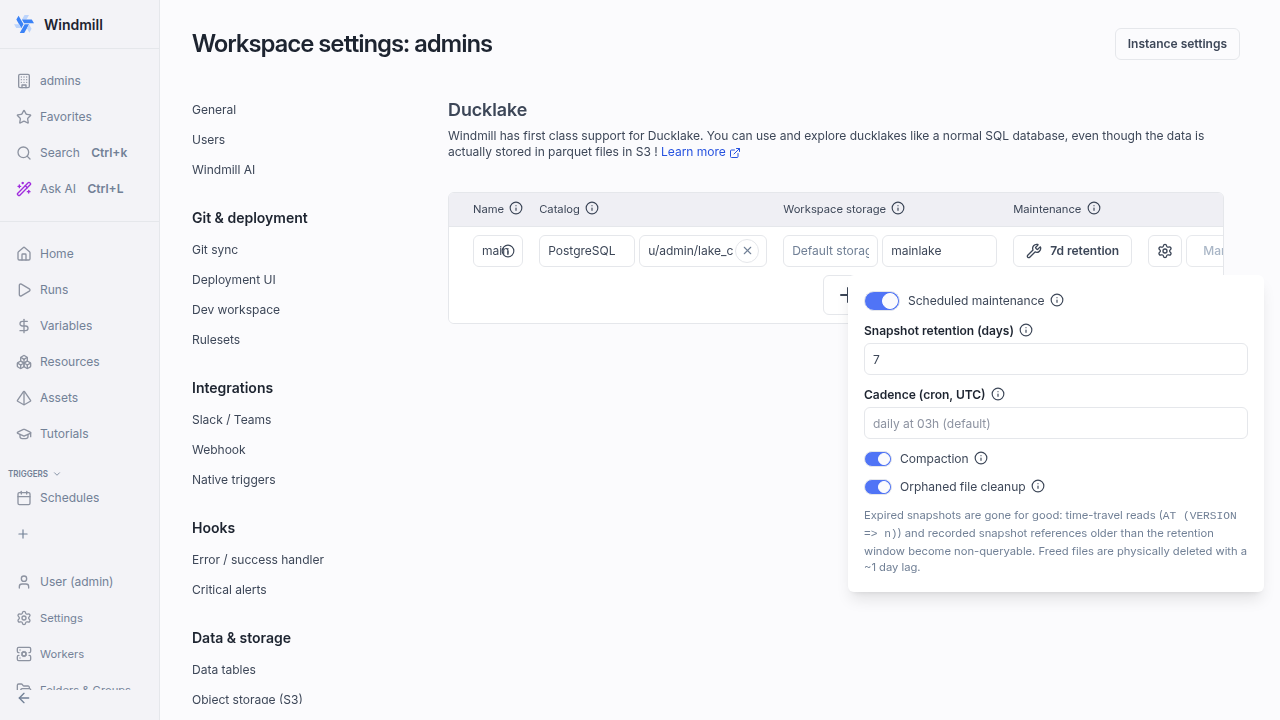
Ducklakes can now run scheduled maintenance to keep growth in check - snapshot expiry with a configurable retention window (default 7 days), compaction of adjacent small parquet files, and orphaned file cleanup. Configured per lake in the workspace Ducklake settings with a cron cadence (default daily at 03h UTC) and executed as observable jobs whose run history is the audit trail. Enterprise feature.
New features
- Per-lake maintenance settings in workspace Ducklake settings - enable toggle, snapshot retention in days (default 7), cron cadence (default daily at 03h UTC with a per-lake minute offset), and individual toggles for compaction and orphaned file cleanup
- Snapshot expiry reclaims files referenced only by snapshots older than the retention window; compaction merges adjacent small parquet files; orphaned file cleanup deletes files no longer referenced by the catalog
- Runs execute as normal jobs on the duckdb tag via a managed schedule at the reserved path f/ducklake_maintenance/<lake>, with run history as audit trail and a one-row summary result (expired snapshots, compacted file groups, cleaned and orphaned files deleted, remaining snapshots)
- Expired snapshots become non-queryable via time-travel (AT (VERSION => n)), so size the retention window to the history you need
- Safety margins - physical file deletion lags expiry by one day so long-running readers are not interrupted, and orphan cleanup never deletes files younger than one day; lake names are validated as [A-Za-z0-9_-]+
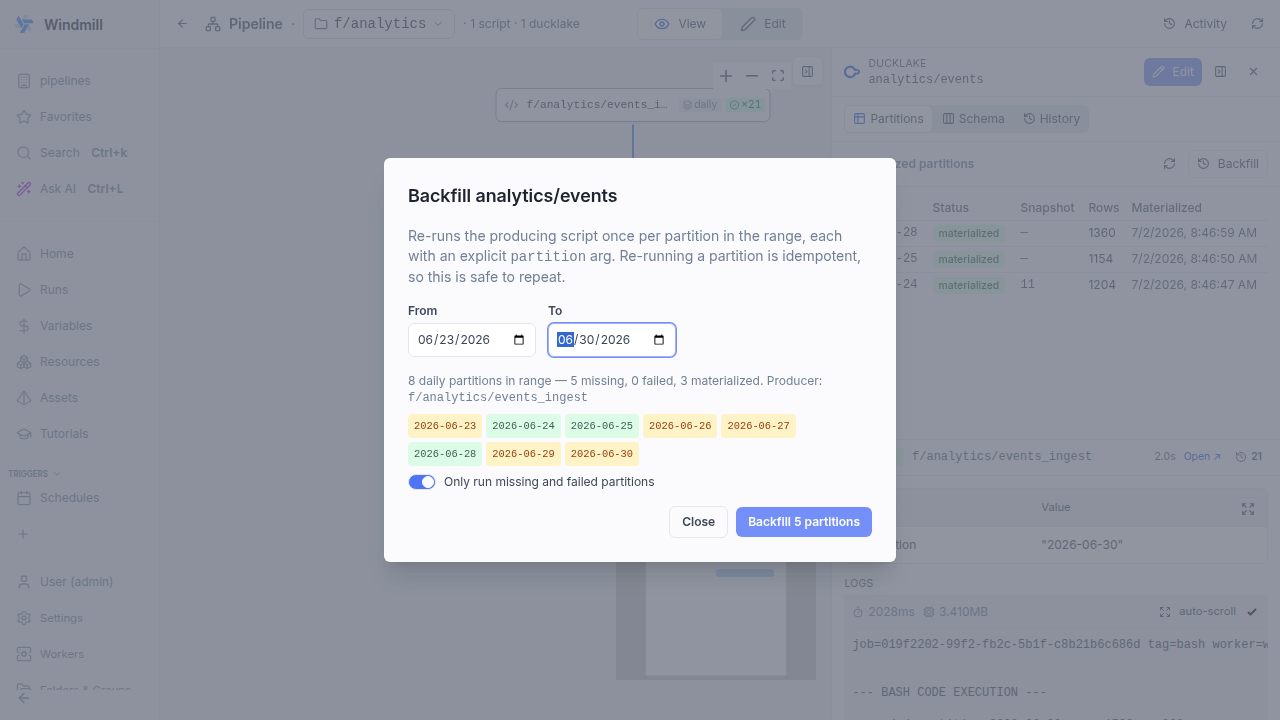
On a partitioned DuckLake asset, the Backfill button opens a range picker that previews which partitions are missing, failed or materialized, then re-runs the producing script once per partition with an explicit partition argument. Runs are sequential and idempotent, a failed partition does not stop the rest, and progress streams in the dialog and drawer header. Range backfill is an Enterprise feature; single-partition runs stay available in all editions.
New features
- Backfill button on the partition-status grid of a materialized ducklake:// asset opens a from/to range picker
- The preview classifies every partition in range as missing, failed or materialized; a toggle (default on) restricts the run to missing and failed partitions
- One deployed run per partition with an explicit partition argument, sequential to avoid catalog commit contention; each run is idempotent
- A failed partition does not stop the rest; progress streams in the dialog and, when closed, in the drawer header while the grid refreshes per slice
- Cancel stops after the in-flight partition and cancels its job
- Headless alternative: wmill pipeline run <folder> --partition <value>
Pair a persistent dev workspace with a prod workspace that can be locked so changes only reach it through promotion. Edit safely in dev, mark resources and variables workspace-specific to keep separate values per environment, and promote manually from Compare & Deploy.
New features
- Persistent dev workspace with a plain, git-branch-safe workspace ID (no wm-fork- prefix)
- Lock the paired prod workspace against direct deploys and forking (reuses protection rulesets)
- On a locked prod, Edit redirects to the dev workspace with an "Edit in <dev>" affordance
- Attach or detach an existing workspace as dev from the Dev workspace settings tab
- Mark resources and variables workspace-specific from Compare & Deploy to keep separate values per environment
- Strictly create-only "Create in <other>" seeds a missing copy (including secrets) without overwriting
- AI chat session picker badges and steers toward the dev workspace on a locked prod
The native Kubernetes autoscaling integration now annotates worker pods with pod-deletion-cost before scaling in, so the ReplicaSet controller deletes idle pods first instead of picking victims blindly. Busy pods are protected proportionally to the age of their oldest running job. The annotation pass is best-effort and requires optional list/patch RBAC on pods; without it, scaling proceeds as before with a warning.
New features
- Before a scale-in, worker pods are annotated with controller.kubernetes.io/pod-deletion-cost.
- Idle pods get cost 0 and are deleted first; busy pods get 10 + the age of their oldest running job in seconds (capped at 1 day).
- Best-effort: missing RBAC, API or DB errors never fail the scaling operation, it falls back to the previous behavior with a warning.
- Requires optional list and patch permissions on pods; the autoscaling health check now warns (non-fatally) if they are missing.
- Honored on Kubernetes 1.22+ where the PodDeletionCost feature gate is enabled by default.
Bash scripts starting with a #ssh <resource_path> directive now run on the remote host described by the referenced ssh_target resource, for jump/utility nodes where no worker can be placed. Full parity with local bash jobs - typed positional args, structured result, live streamed logs, cancellation and remote exit-code propagation. Enterprise feature, off by default (ssh_execution_enabled instance setting). Agent workers remain the recommended way to run code in isolated environments.
New features
- Add `#ssh <resource_path>` as the first comment line of a bash script to run it on the remote host of an `ssh_target` resource.
- Full parity with local bash jobs: typed args, result collection (result.json > result.out > last stdout line), live logs, cancellation, remote exit code fails the job.
- Dynamic target with `#ssh $<arg_name>`: the target resource path is supplied as a job argument at call time, resolved through the runner resource permissions.
- Host-key pinning enforced when the resource sets `host_pubkey`; trust-on-first-use only with explicit `accept_unknown_host`.
- Enterprise-gated and off by default: enable the `ssh_execution_enabled` instance setting as a superadmin.
- A userland wrapper (`ssh_exec.sh` / `ssh_exec.py`) with the same SSH mechanics is available without a license in examples/usecase/ssh-execution-wrapper.
When OTEL tracing is enabled, a job run through a webhook or REST endpoint with a W3C traceparent header is connected to the caller's distributed trace. The job span and its flow step and script spans are relocated under the caller's span so the whole execution appears as one end-to-end trace, instead of as a separate one.
New features
- A traceparent header on the run endpoints connects the job to the inbound distributed trace.
- The job span, its flow steps and script subprocess relocate under the caller span in your tracing backend.
- The inbound traceparent is exposed as the TRACEPARENT env var and propagated to every flow step.
- Invalid traceparent headers are ignored, so the job_id / root_job trace lookup keeps working.
Bash scripts can now run any container image with the # sandbox <image> annotation. The image rootfs is pulled with crane and run chrooted inside the job's own nsjail, so it is daemonless, needs no Docker socket or dind sidecar, and is safe to run for untrusted multi-tenant code. Docker scripts are now allowed on Windmill Cloud.
New features
- Run any container image from a bash script with `# sandbox <image>` — the body runs inside the image, sandboxed.
- Daemonless: image rootfs is pulled with crane and run chrooted in the job nsjail, no Docker socket or dind sidecar.
- Inherits the job confinement: no host filesystem, the jail own /proc, unprivileged worker uid, the job network.
- Instance settings for pull policy, per-image and cache size caps, default registry, and private-registry auth.
- Now available on Windmill Cloud since containers run sandboxed.
Continuously export audit logs as newline-delimited JSON to a dedicated logs/audit/ folder in instance object storage, for SIEM forwarding and archival.
New features
- Opt-in export of audit logs to S3, Azure Blob or Google Cloud Storage
- Newline-delimited JSON written to a dedicated logs/audit/ folder, partitioned by day
- Incremental and runs in the background off the audit log hot path, with a single exporter under high availability
- Exported files are never deleted from object storage, so database retention can be set much lower
- Recommended setup to forward audit logs to a SIEM for long-term security analysis
Trigger scripts and flows in response to Azure Event Grid events from custom topics, system topics, domains, and Event Grid Namespaces.
New features
- Subscribe to Azure Event Grid basic topics, system topics and domains (basic_push mode).
- Subscribe to Event Grid Namespace topics with CloudEvents 1.0 push or pull delivery.
- Service Principal authentication; the Azure subscription is derived from the topic or namespace ARM path.
- Auto-discovery of topics and namespaces the service principal can access via ARM.
- Server-managed shared-secret authentication on inbound push webhooks.
- Lock-token ack/reject on namespace pull, enabling dead-lettering and batched consumption.
- Optional event-type filters per trigger.
- Capture mode uses an isolated -wm-capture subscription so tests never clobber the deployed trigger.
Workspace forks now include data tables, and the new wmill workspace merge command enables merging forks back to the parent.
New features
- Data tables are included when forking a workspace.
- New wmill workspace merge CLI command.
- Color support in forked workspaces.
Store Windmill secrets in AWS Secrets Manager as an alternative to the database, HashiCorp Vault, or Azure Key Vault.
New features
- AWS Secrets Manager as a third external secret storage backend.
- Supports static credentials or the default AWS credential chain (IAM roles, env vars).
- Configurable prefix and custom endpoint for LocalStack.
- Bidirectional migration between backends.
Store Windmill secrets in Azure Key Vault as an alternative to the database or HashiCorp Vault.
New features
- Azure Key Vault as a secret storage backend.
- Configured via Key Vault URL and service principal credentials.
- Same migration and fail-closed semantics as Vault.
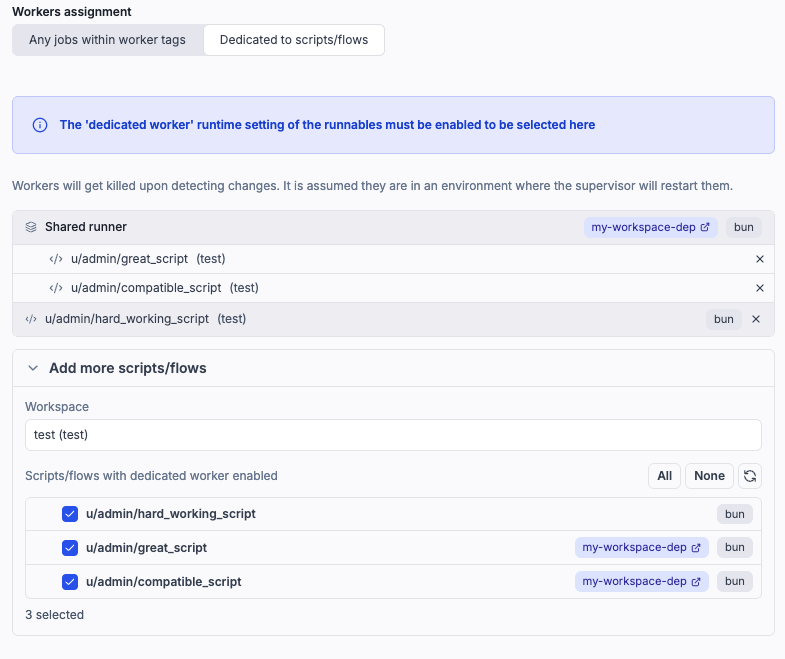
Dedicated worker scripts sharing the same workspace dependency and language now automatically run in a single long-lived subprocess.
Create workspace-scoped automation identities that cannot log in directly, for CI/CD pipelines and API integrations.
New features
- Workspace-scoped service accounts that cannot log in.
- Always operators with a username-only identity.
- Admin impersonation for testing permissions.
SCIM PATCH with active:false now disables users at the instance level instead of deleting them. Admins can also manually disable users.
New features
- SCIM deprovisioning disables users instead of deleting them.
- Disabled users cannot log in but retain workspace memberships.
- Manual enable/disable from instance settings.
Add per-step debouncing to flow nodes to consolidate repeated executions of a specific step within a flow.
New features
- Per-step debounce node in the flow editor.
- Configurable delay, custom debounce key, and argument accumulation.
- Max debouncing time and max debounce count limits.
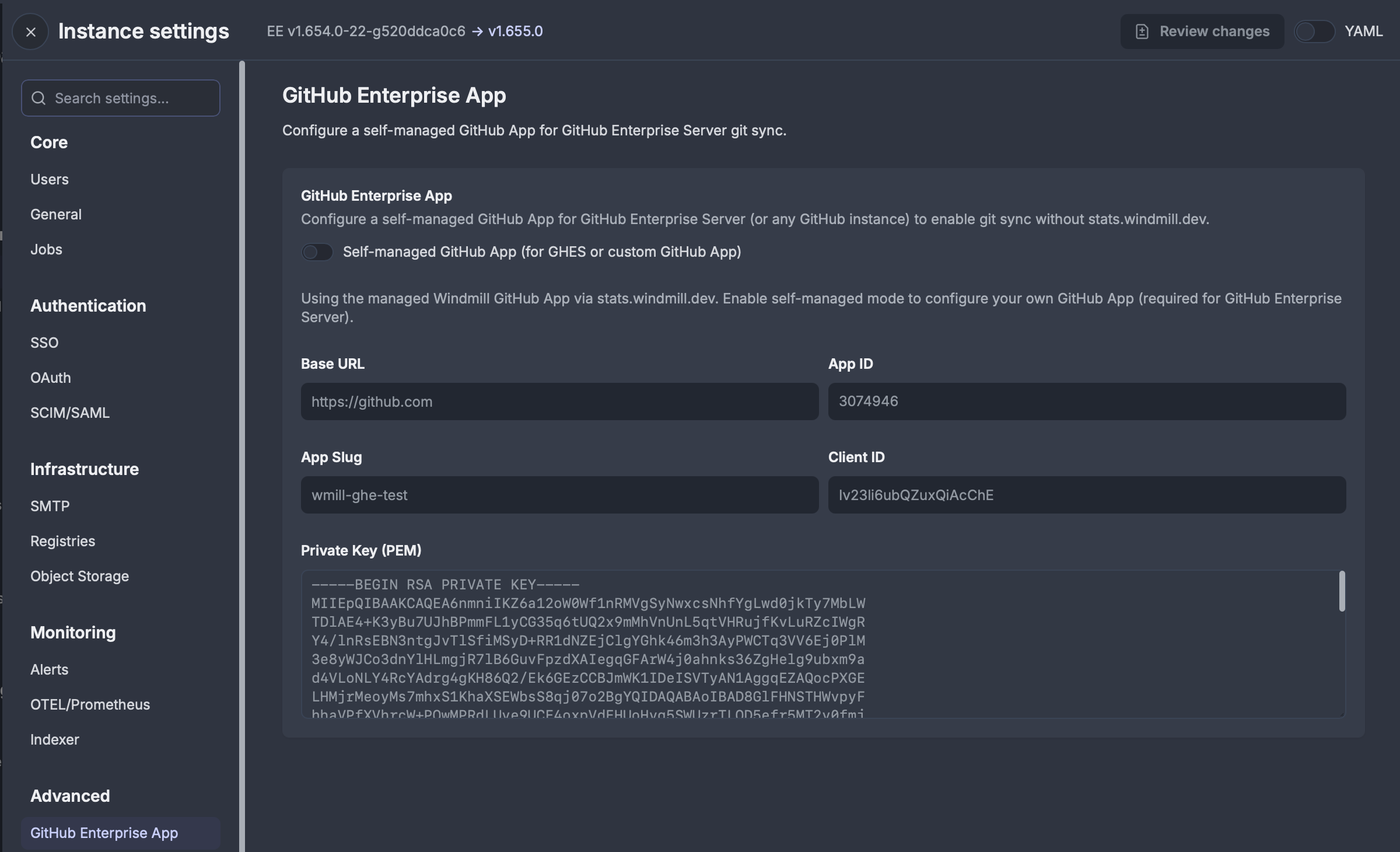
Self-managed GitHub App support for GitHub.com and GitHub Enterprise Server instances, enabling Git sync without relying on the Windmill-managed GitHub App.
New features
- Register your own GitHub App on GitHub.com or GitHub Enterprise Server for Git sync authentication.
- Self-managed JWT token generation and exchange directly with your GitHub instance.
- Host-based installation filtering prevents token leakage across GitHub instances.
Persistent volumes for scripts via code annotations, per-script sandbox annotation for Python and TypeScript, and AI sandbox for running coding agents with isolation and persistent state.
New features
- Volumes: persistent file storage attached to scripts via comment annotations, synced to workspace object storage.
- Dynamic volume names with $workspace and $args[...] interpolation.
- Per-worker LRU volume cache (10 GB) with exclusive leasing for concurrency safety.
- Per-script sandbox annotation (#sandbox / //sandbox) now supported for Python and TypeScript in addition to Bash.
- AI sandbox: sandboxing + volumes pattern for running AI coding agents (Claude Code, Codex, OpenCode) with persistent state.
- Built-in Claude Code template using the Claude Agent SDK with volume-backed session persistence.
- Volumes UI in the Assets page for browsing, exploring, and deleting volumes.
- Community Edition volume limits: max 20 volumes per workspace, 50 MB per file.
Approval steps in workflows as code now expose a selfApproval flag (TypeScript) and self_approval (Python) to control whether the user who triggered the workflow can also approve it, matching the visual flow editor toggle.
New features
- New selfApproval / self_approval parameter on approval steps in workflows as code.
- Set to false to require a different approver, matching the visual flow editor toggle.
- Available in the TypeScript and Python WAC SDKs.
MS SQL Server resources can now authenticate using Azure AD (Entra) OAuth tokens through the aad_token field, alongside username/password and Windows Integrated Authentication. Uses the Windmill Azure OAuth setup with the database.windows.net scope.
New features
- Azure AD (Entra) authentication for MS SQL Server resources via the aad_token field.
- Three authentication methods supported: username/password, Azure AD, and Windows Integrated Authentication.
- Uses the Windmill OAuth setup with the https://database.windows.net//.default scope.
Configure private package registries for npm, Maven, and Cargo from instance settings. Supports .npmrc for npm/Bun/Deno, settings.xml for Maven/Java, and config.toml for Cargo/Rust.
New features
- .npmrc support for npm private registries, compatible with Bun (1.1.18+), Deno 2.x, and npm proxy.
- Maven settings.xml configuration for private Maven repositories, written to {JAVA_HOME}/.m2/settings.xml.
- Cargo config.toml for private Cargo registries, written to .cargo/config.toml in the job directory.
- All private registry configurations are Enterprise Edition features.
Manage Windmill instance configuration declaratively with YAML files, a Kubernetes operator, or the CLI. Version-control, review, and reproduce your setup across environments.
New features
- Declarative YAML configuration for global settings and worker groups.
- Kubernetes operator with ConfigMap-based continuous reconciliation and drift detection.
- sync-config CLI command for Docker Compose and VM deployments.
- Secret references via envRef (environment variables) and secretKeyRef (Kubernetes Secrets API).
- Export current instance configuration as YAML from the UI or CLI.
Enforce governance policies on workspaces by disabling direct deployments or workspace forking. Configure bypass permissions for specific users or groups.
New features
- Disable direct deployment to enforce review workflows
- Disable workspace forking to control development environments
- Configure bypass permissions for users or groups
- Works with Git Sync and Deploy to Prod workflows
Kafka triggers now support message filtering. Define key/value pairs to filter messages before they trigger a job. Uses JSON superset matching — the message value at a given key must contain all fields from the filter value.
New features
- Key/value-based message filtering for Kafka triggers
- JSON superset matching for flexible filtering
- Shared filter component with WebSocket triggers
- Filter preview in the trigger editor UI
Capture HTTP requests made by job scripts as observability spans
New features
- View HTTP request traces (method, URL, status, timing) in the job details UI
- Auto-instrumentation for Native TypeScript, MITM proxy for other languages
- Integrates with external OpenTelemetry collectors
DuckDB scripts can now write data to Azure Blob Storage in addition to reading. Supports Parquet, CSV, and JSON formats when Azure Blob is configured as workspace storage.
New features
- DuckDB write support for Azure Blob Storage
- Works with Parquet, CSV, and JSON formats
Configure a script to run automatically when jobs complete successfully in the workspace. The counterpart to the workspace error handler — receives the job result, path, and metadata. Cached with a 60-second TTL.
New features
- Workspace-level success handler triggered on job completion
- Receives job result, path, email, job_id, and metadata
- Configurable from workspace settings with template support
- 60-second cache for handler settings
Windmill autoscaling now supports native Kubernetes integration, providing easier setup, improved reliability, and enhanced security compared to custom script-based solutions.
New features
- Native Kubernetes autoscaling without custom scripts.
- Automatic worker-group, namespace and credentials inference.
- RBAC-based security with deployment scaling permissions.
- Health check validation for proper configuration.
- Seamless integration within existing Kubernetes clusters.
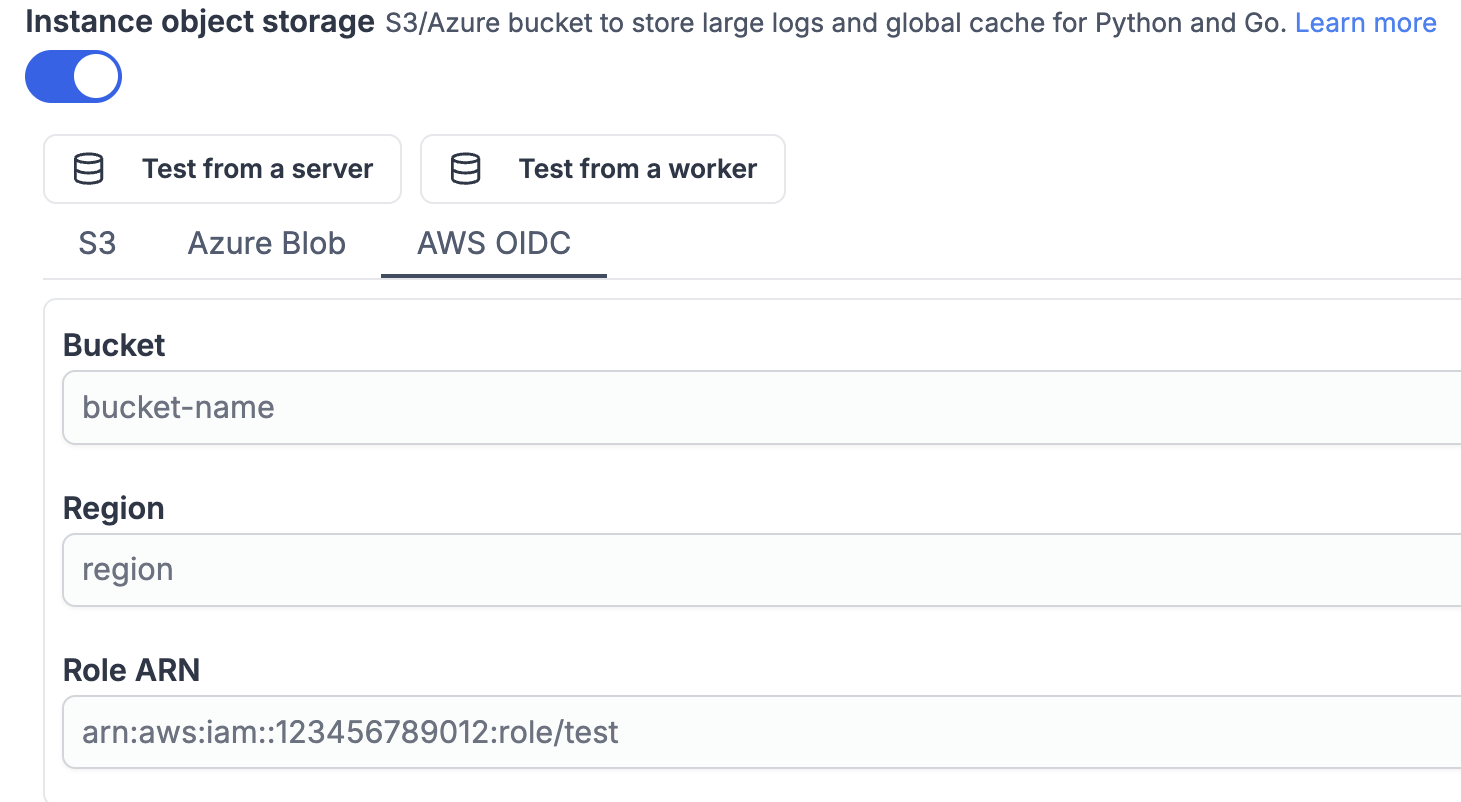
Windmill now supports using AWS OIDC for instance object storage configuration.
New features
- Added AWS OIDC support for instance object storage
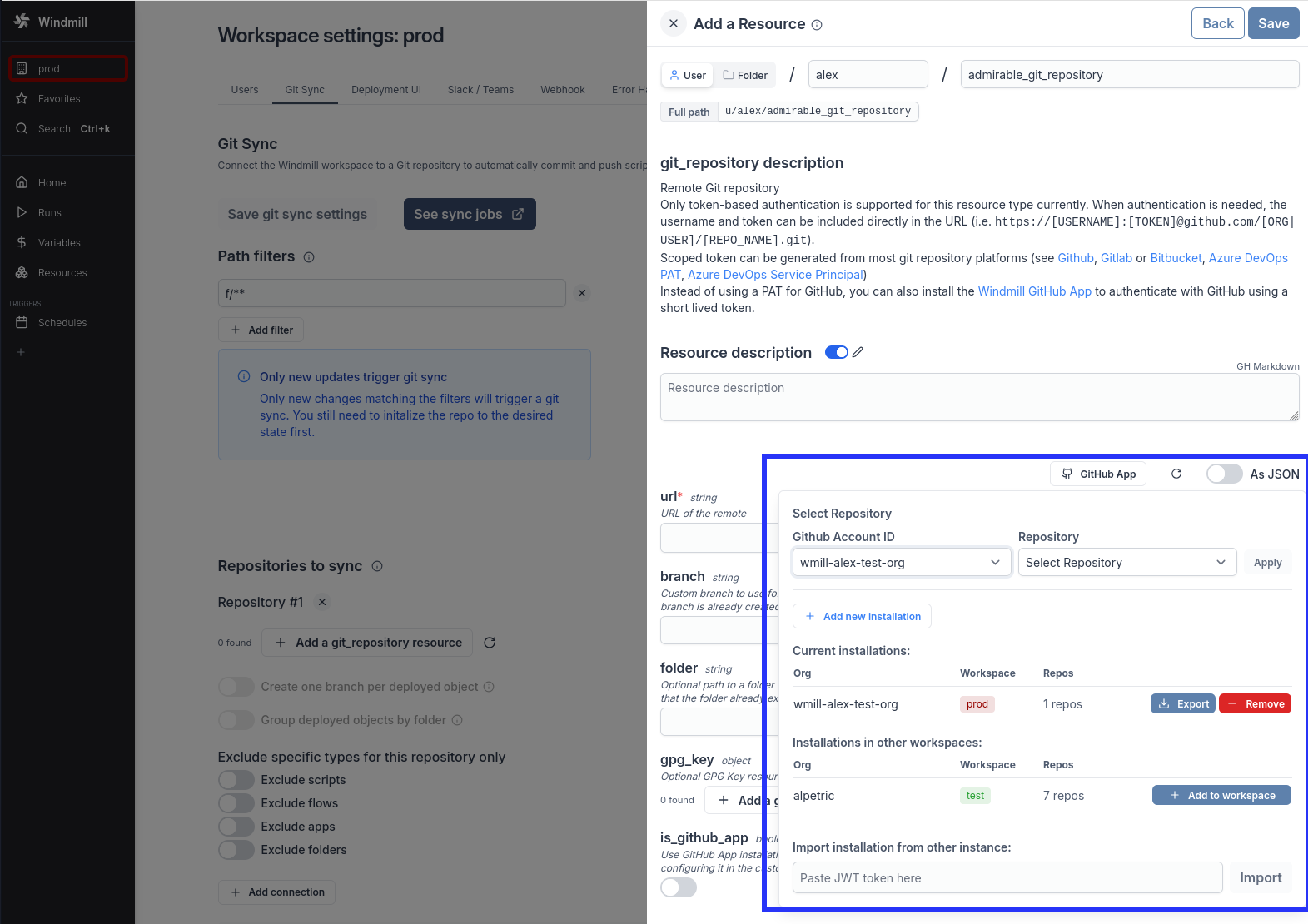
Install the Windmill GitHub App instead of using a long lived personal access token (PAT) to authenticate with GitHub for Git sync
New features
- No need for long lived GitHub personal access token
- Improved controls over repo access from Windmill using the App installation scope
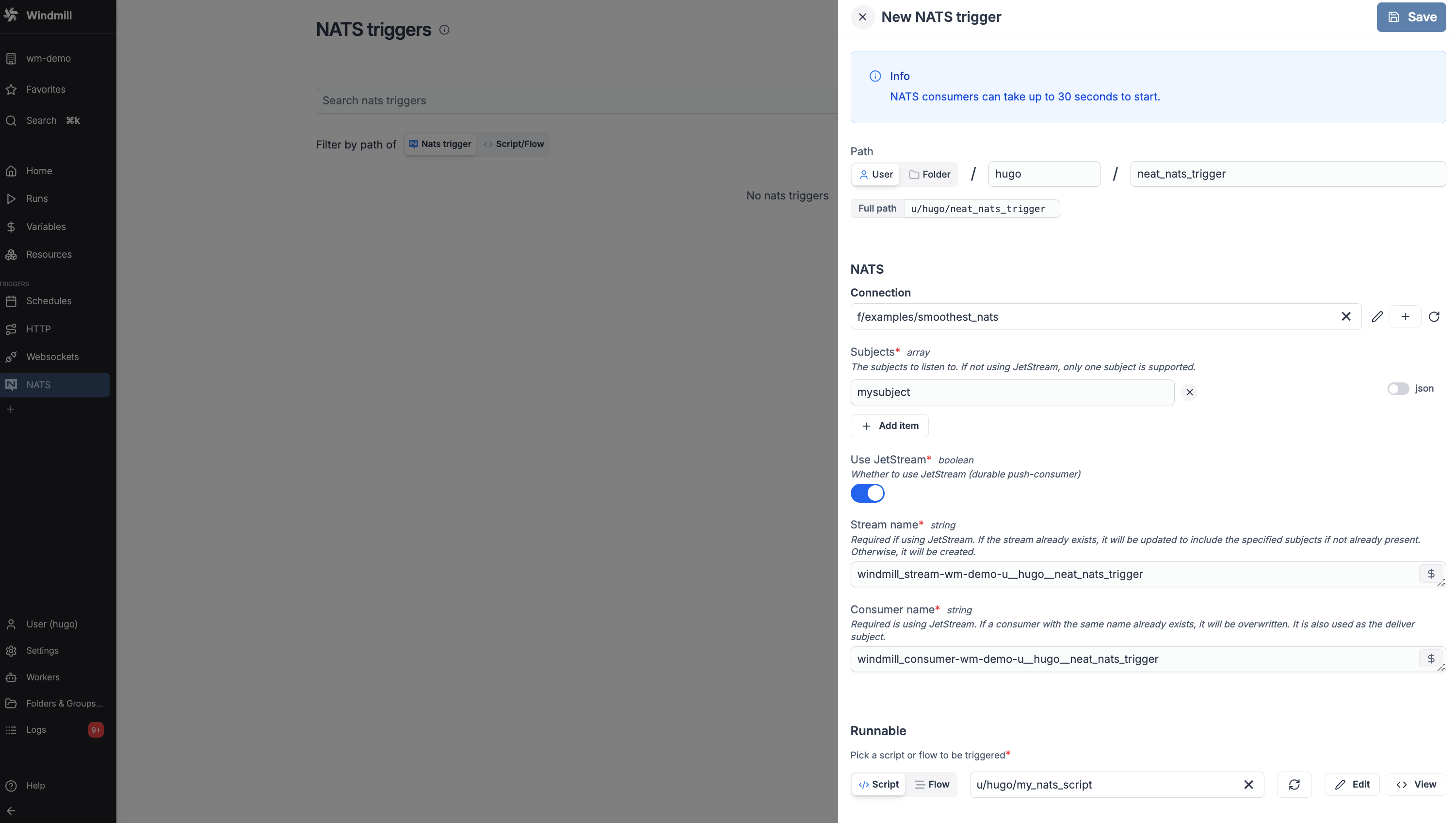
Support for NATS triggers to run jobs when messages are received.
New features
- Add support for NATS triggers to run scripts and flows when messages are received from NATS subjects
- NATS triggers run on the server side without consuming worker resources
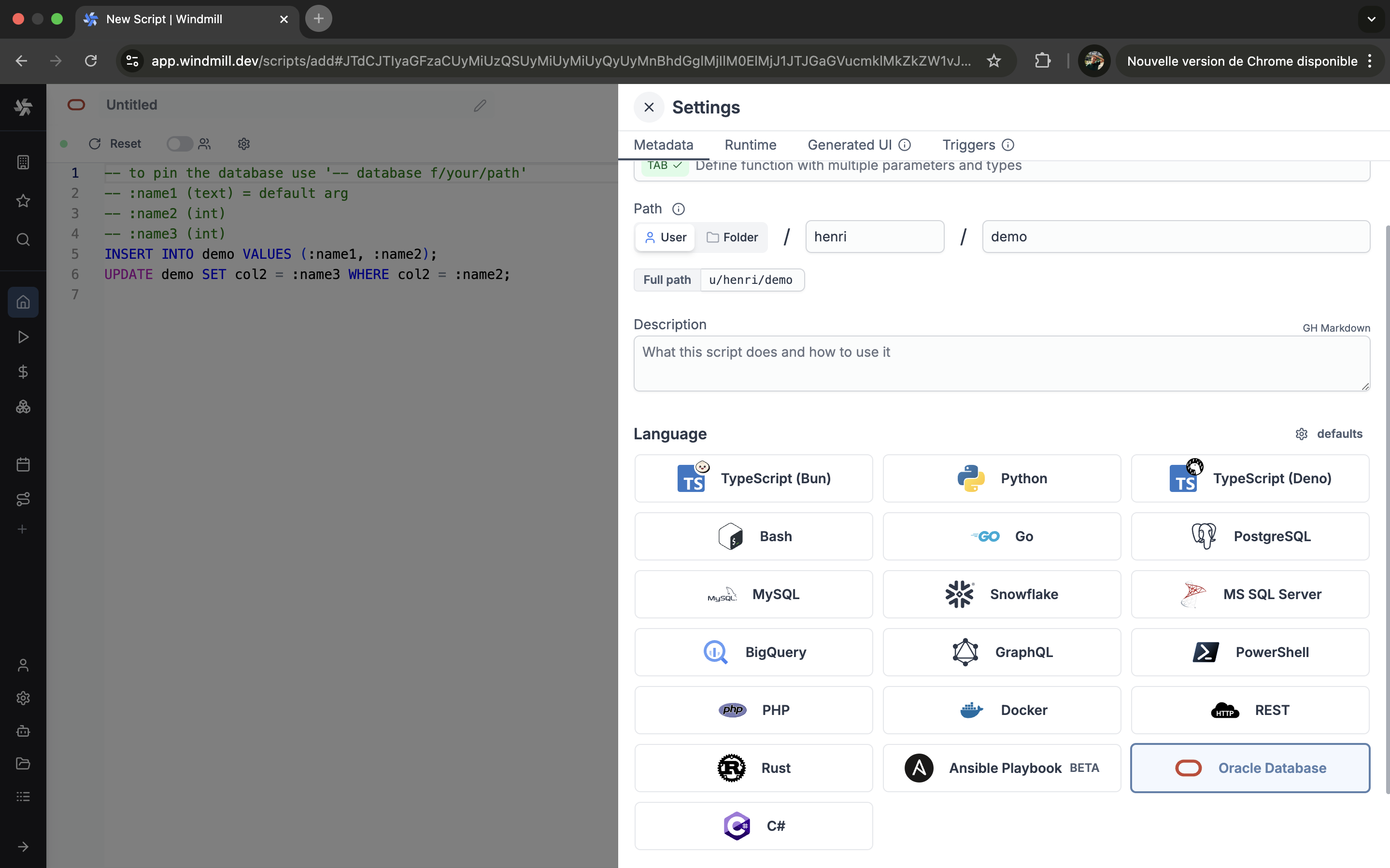
Windmill now supports Oracle scripts.
New features
- Write your Windmill script in Oracle.
- Run your Oracle scripts locally or in the cloud.
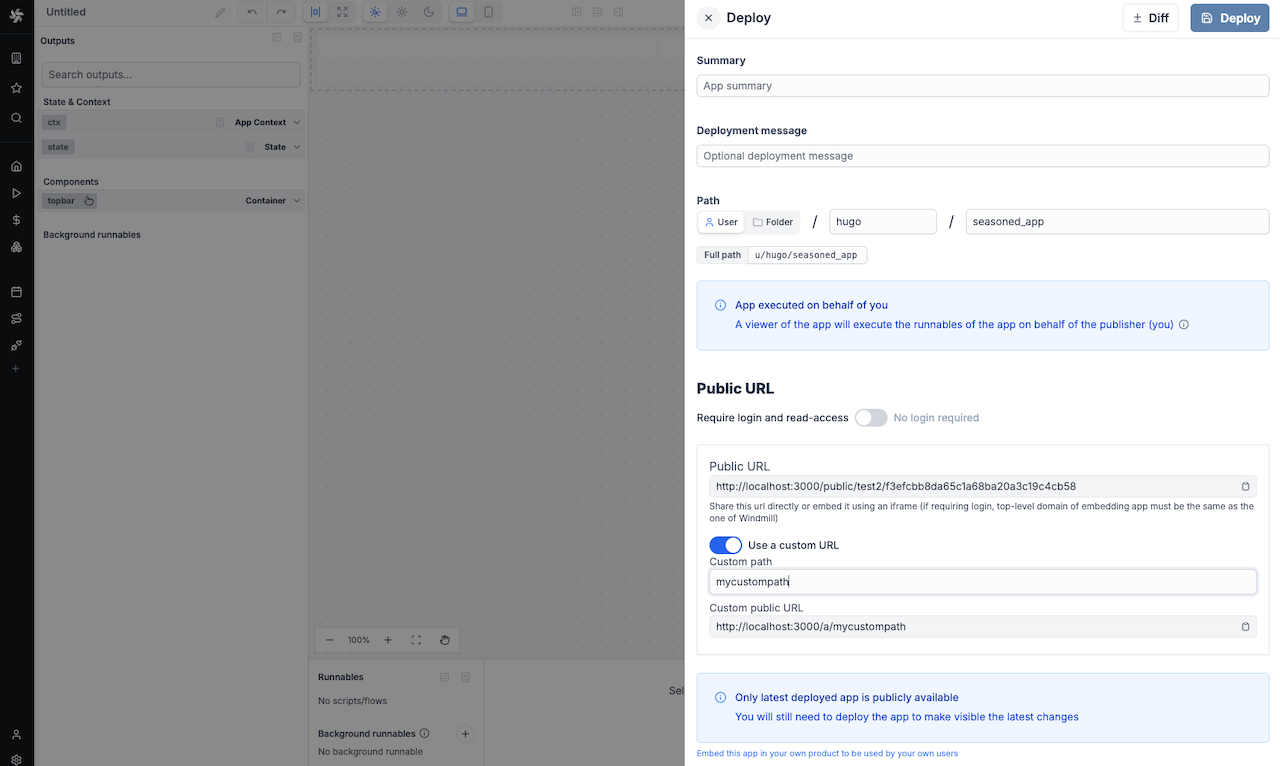
Cloud and enterprise users can now set a custom public URL for their app.
New features
- Set a custom public URL for your app
Enterprise users can now search jobs and logs using our new indexer service powered by the rust search engine Tantivy.
New features
- Updated helm charts to run the indexer service and enable full text search
- Search jobs from anywhere, querying path, args, results or even job logs
- Minimal grafana-like tool to explore service logs
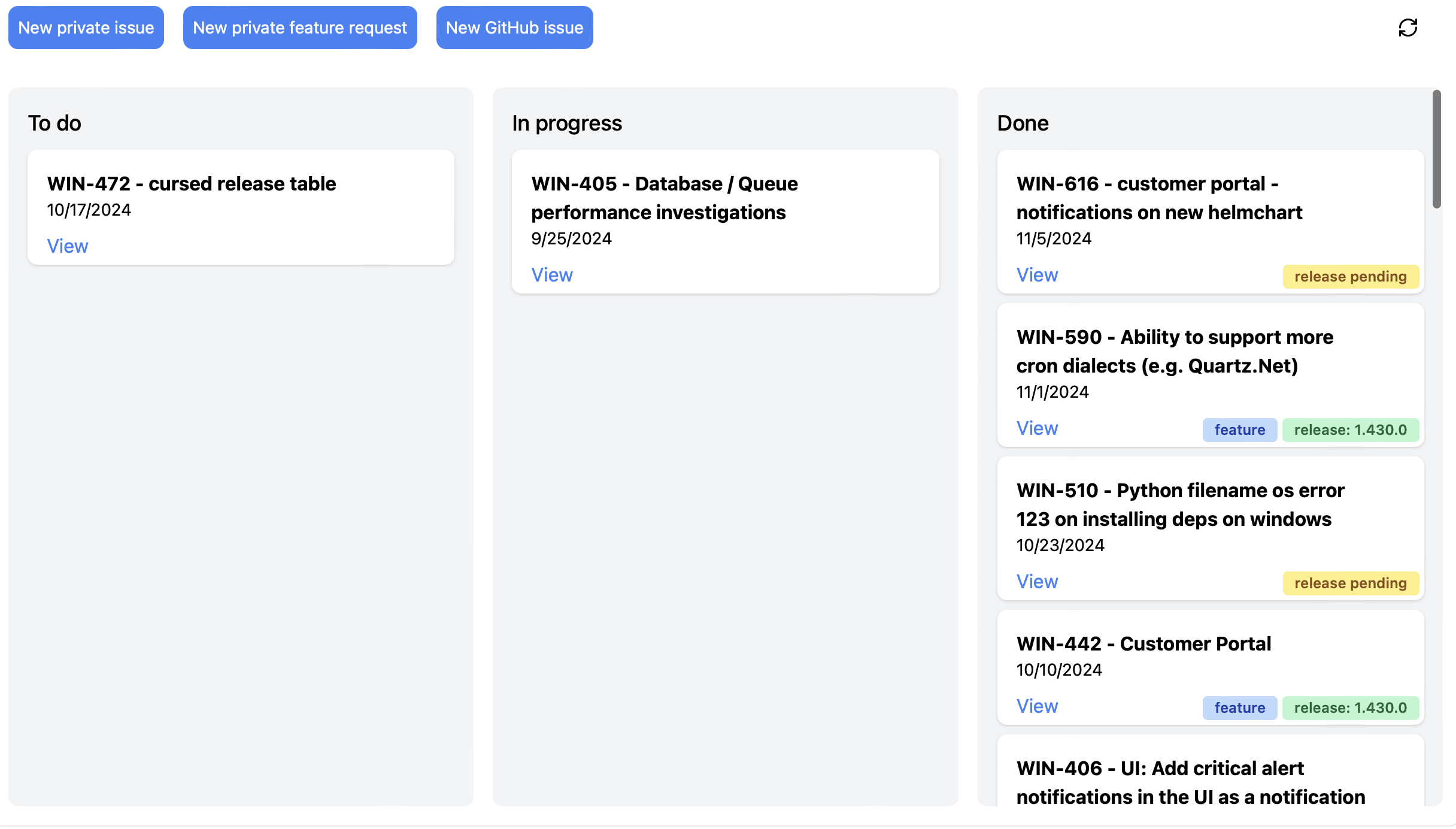
Enterprise users now have access to a dedicated dashboard for tracking feature requests and issues.
New features
- Private issue tracking dashboard
- Feature request tracking
- Automatic email and Slack/Discord notifications
- GitHub integration for issue tracking
- Release tracking and notifications
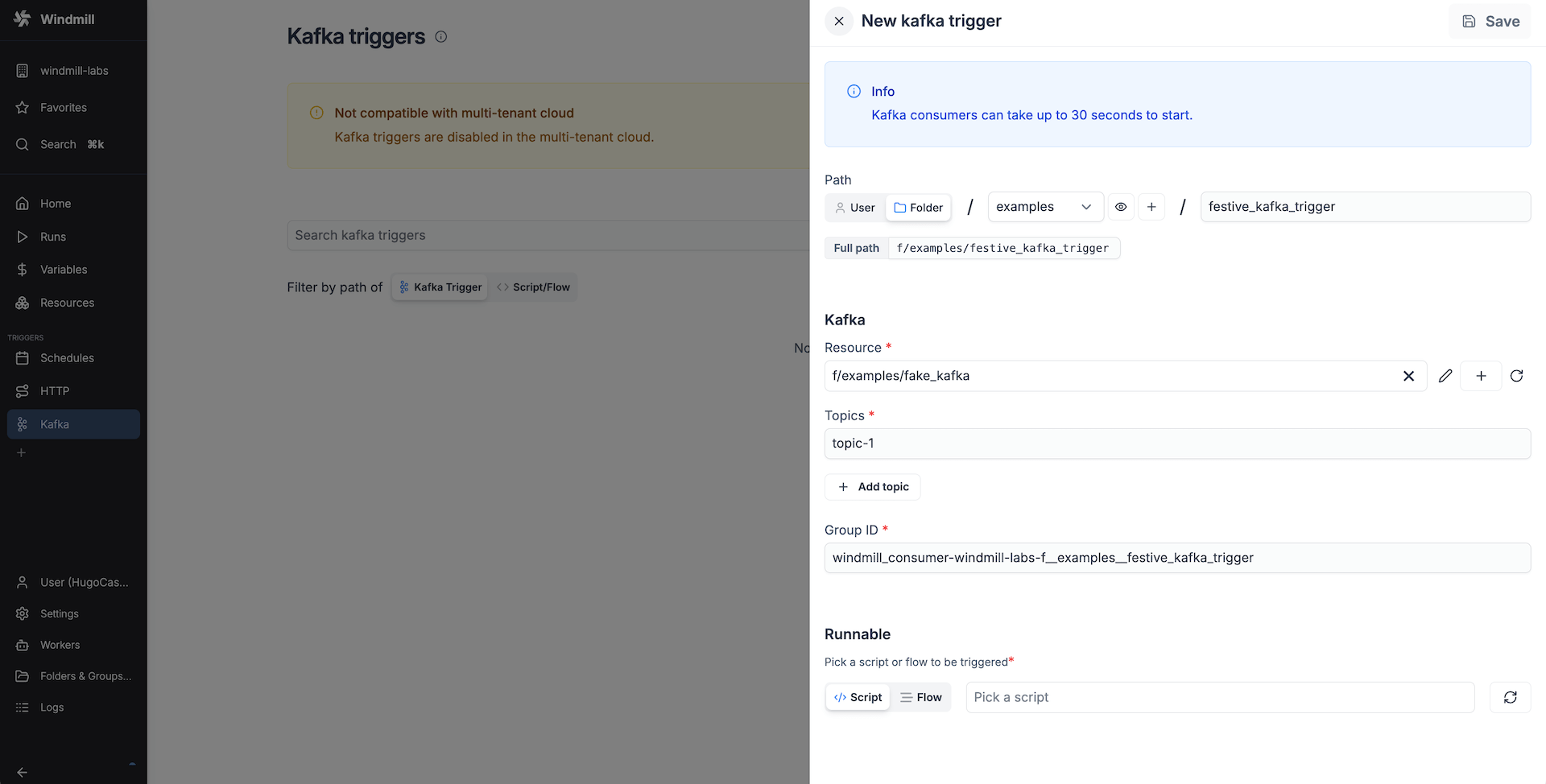
Support for Kafka triggers to run jobs when messages are received.
New features
- Add support for Kafka triggers to run scripts and flows when messages are received from Kafka topics
- Kafka triggers run on the server side without consuming worker resources
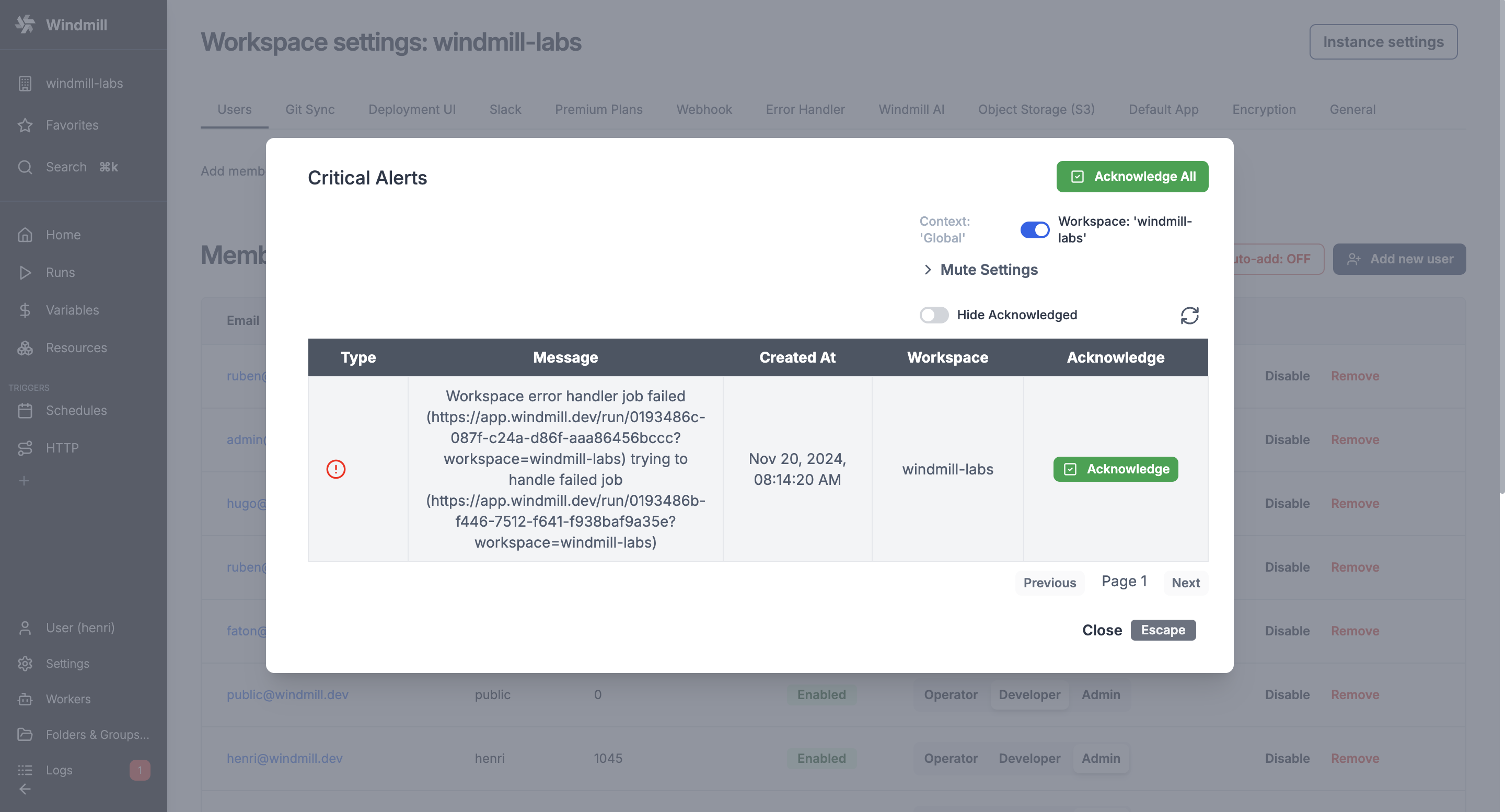
Critical alerts notifications are now displayed in the UI.
New features
- Critical alerts notifications are now displayed in the UI
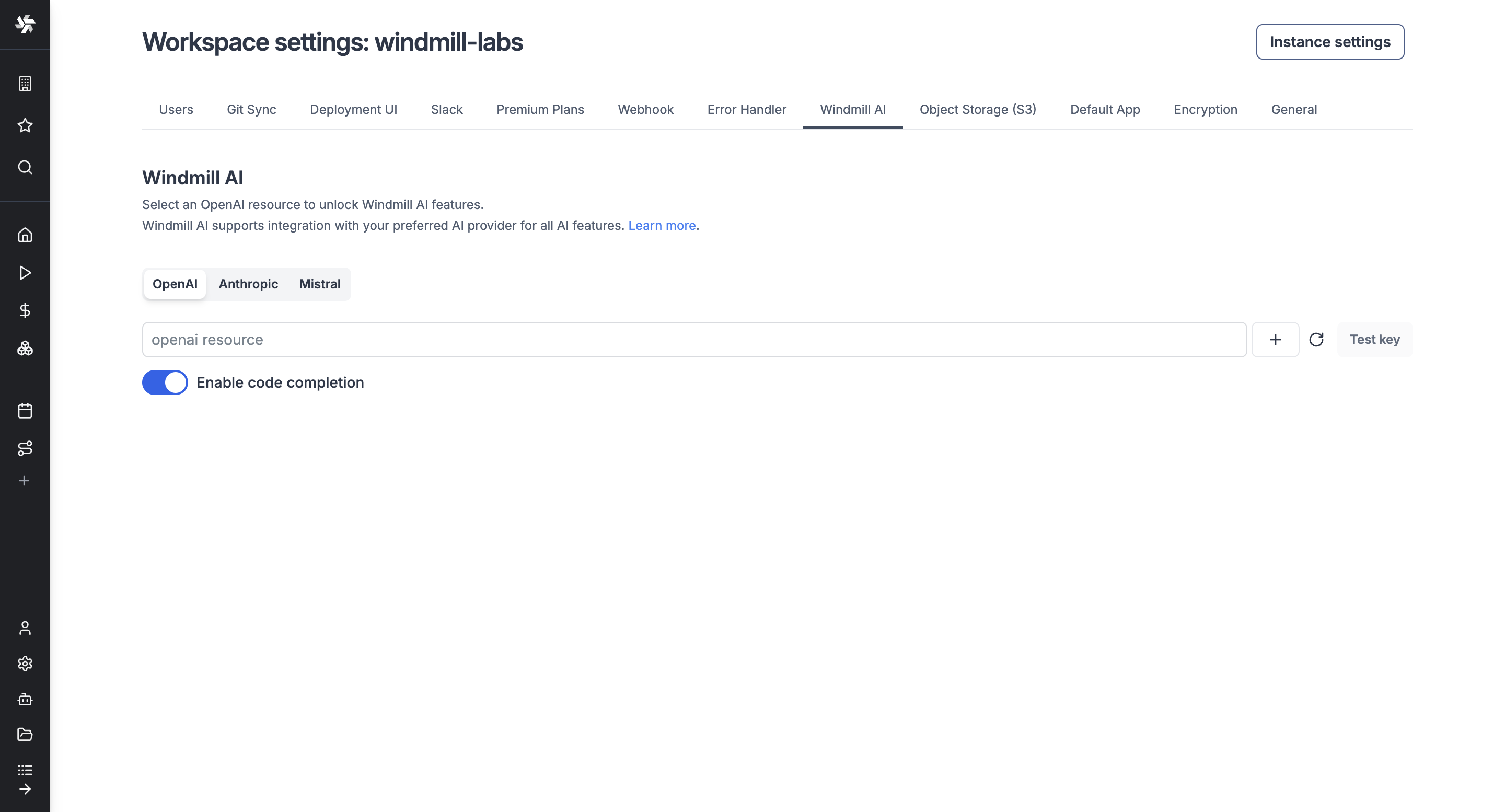
Windmill AI now supports Mistral's Codestral and Anthropic's Claude 3.5 models.
New features
- Added support for Mistral Codestral model
- Added support for Anthropic Claude 3.5 model
Support for WebSocket triggers to run jobs when messages are received.
New features
- Connect to WebSocket servers and trigger scripts/flows when messages are received
- Support for both static WebSocket URLs and dynamic URLs generated by scripts/flows
- Configure initial messages for authentication or subscriptions
- Filter incoming messages using JSON path matching
- Server-side listening without consuming worker resources
Worker autoscaling automatically adjusts the number of workers based on your workload demands.
New features
- Automatic worker scaling based on workload demands
- Configurable min/max worker limits
- Support for custom scaling scripts
- Occupancy-based scaling decisions
- Cooldown periods to prevent scaling thrashing
- Detailed autoscaling event logging
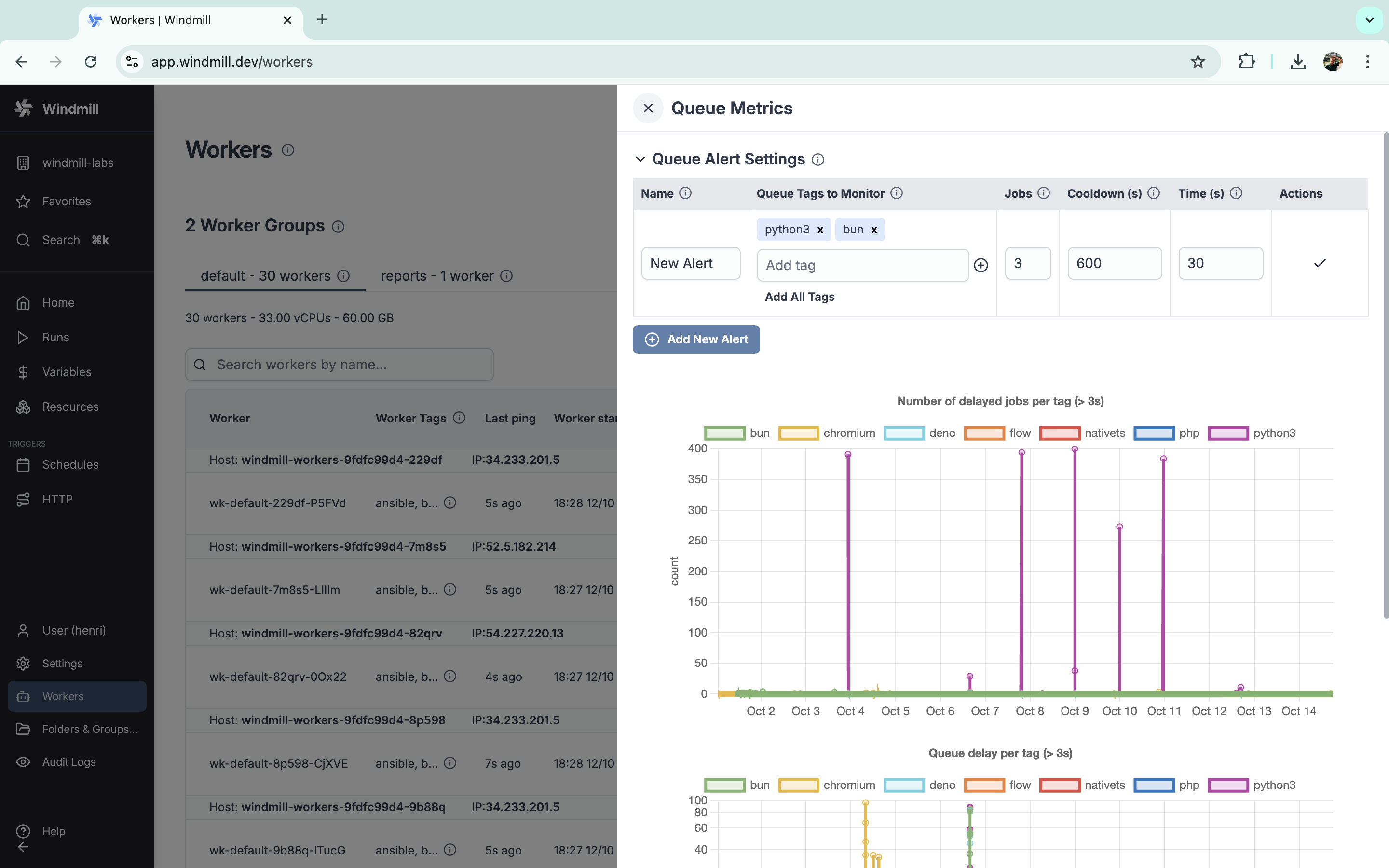
Critical alerts for jobs waiting in queue.
New features
- Add functionality to monitor job queues and trigger alerts for waiting jobs, with UI for alert management in enterprise feature.
- The "cooldown" parameter determines the minimum duration between two consecutive alerts if the number of waiting jobs are fluctuating around the configured threshold.
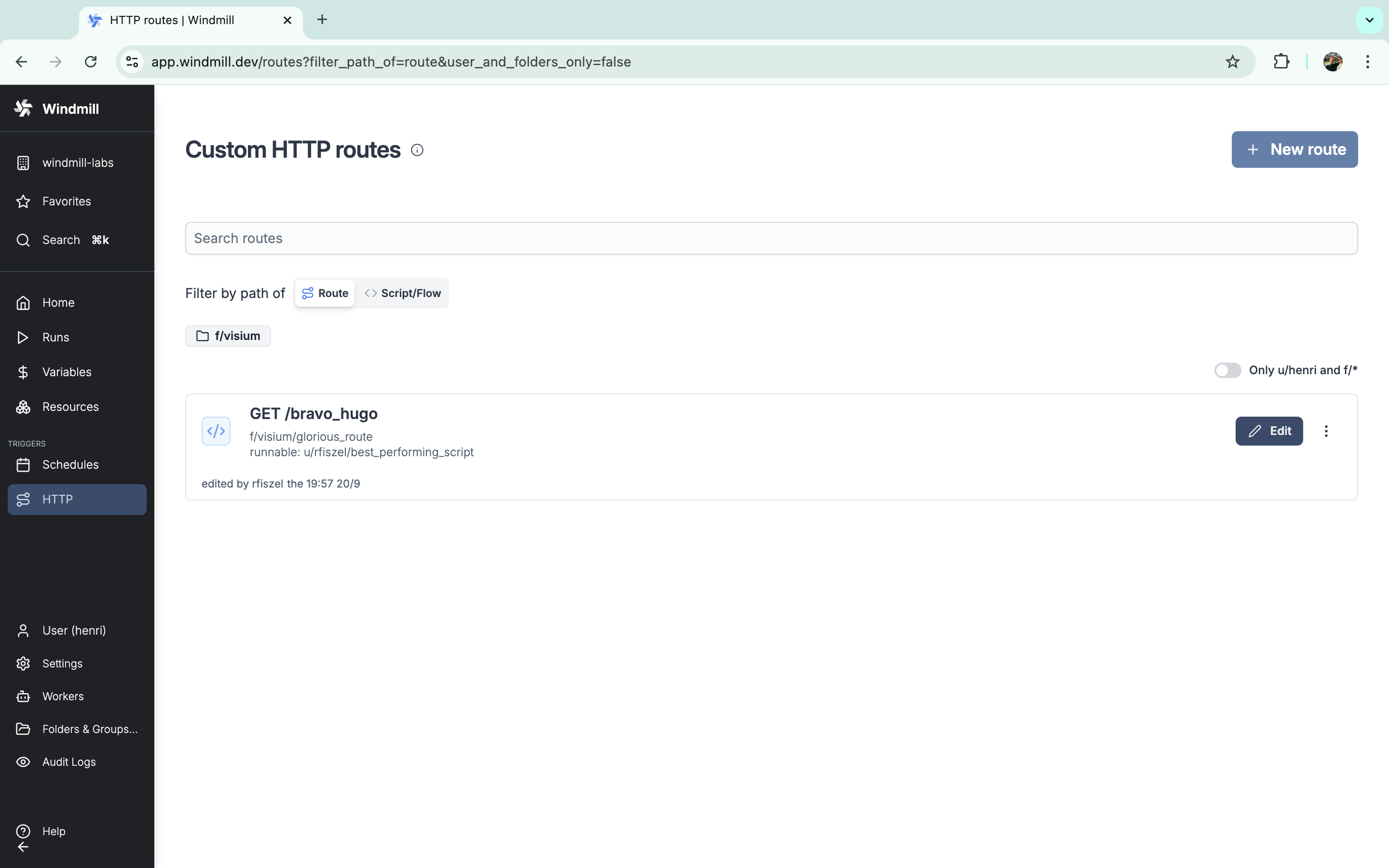
Windmill supports custom HTTP routes to trigger a script or flow.
New features
- Trigger a script or flow via a custom HTTP route.
- Use a preprocessor to transform the request before it is passed to the runnable.
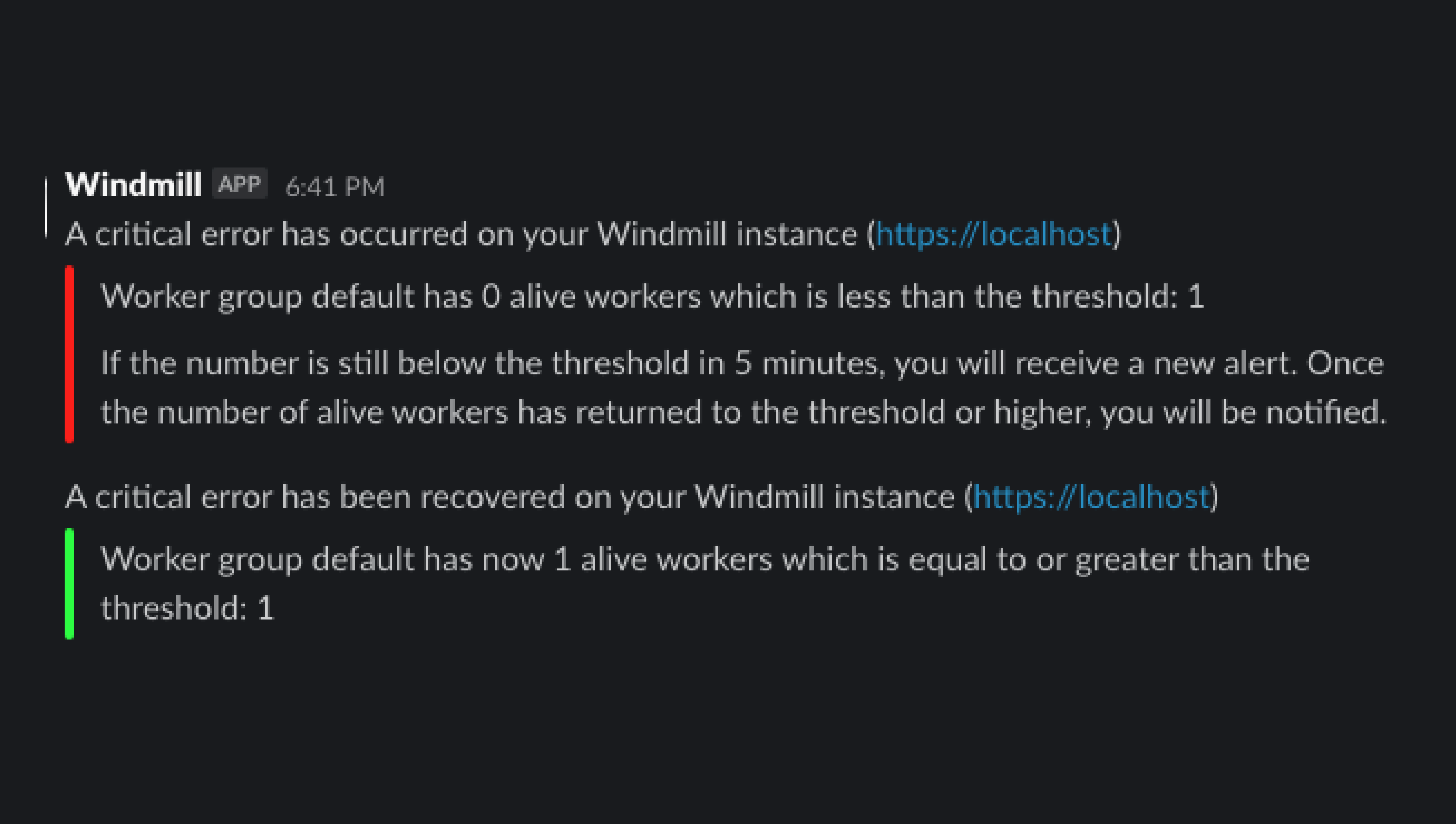
Get a notification everytime on critical events such as when a job is re-run after a crash.
New features
- Get email or Slack notifications for critical events such as everytime a job is re-run after a crash.
- You can set an alert to receive notification via Email or Slack when the number of running workers in a group falls below a given number.
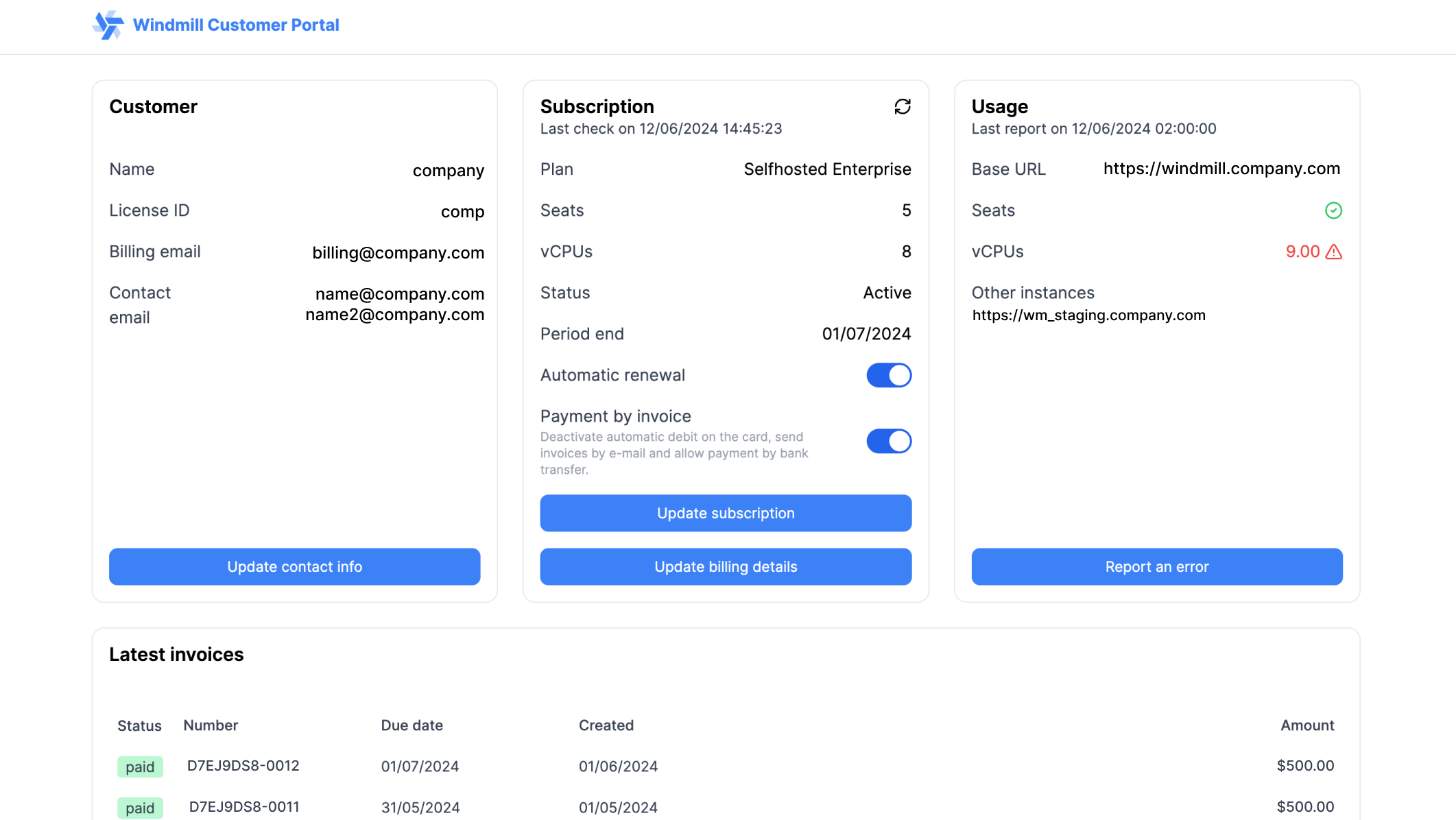
We have released our new Windmill Billing Portal https://portal.windmill.dev/.
You can access your Portal from your Instance settings, in the "Core" tab. Or by visiting https://portal.windmill.dev/, entering your email and then accessing the link sent via email. Update contact information, billing details and subscription (seats & workers) from the portal. From there, you can also enable/disable any time automatic renewal and automatic debit (therefore payment by invoice).
In the Usage section, you can find the seats of workers usage of your Prod instance, and check whether your use of Windmill corresponds to your subscription. There is a ‘Report an error’ button, please use it if reported usage is incorrect.
It's also an opportunity for us to explain our new way of managing license keys for self-hosted instances.
As you know, when you subscribe to Windmill, you receive a license key to enter in the instance settings. Now, this key automatically updates every day as long as the subscription is valid. A key is valid for 35 days and expires as soon as an updated key replaces it. This system relieves you from having to worry about your key expiring. Now everything is automatic as long as your subscription is valid. You can still contact us for exceptions.
New features
- Windmill Billing Portal available at https://portal.windmill.dev/
- See info on subscription and usage.
- Update contact info from your portal.
- Update subscription and billing details.
- Automatic license key renewal.
If configured, users who are operators in this workspace will be redirected to this app automatically when logging into this workspace.
New features
- Set an app to pop up when an operator logs into the workspace.
- Make sure the default app is shared with all the operators of this workspace before turning this feature on.