Measures and dimensions (DuckDB)
On the DuckDB script that materializes a DuckLake table, you can declare what that table's canonical aggregations and slicers are, next to the -- materialize line:
-- pipeline
-- materialize ducklake://sales/orders
-- measure revenue = sum(amount) where not is_refund
-- measure order_count = count(*)
-- dimension region = region
-- dimension month = date_trunc('month', ordered_at)
SELECT ...
A measure is an aggregation; a dimension is a slicer any measure can be grouped by. They are declared once, on the producing table, so that "revenue means sum(amount) excluding refunds" lives with the table rather than being re-derived - and re-guessed - in every query that needs it.
These declarations are catalogued at deploy and read back by two consumers: the script editor's Metrics drawer, and AI agents via MCP. That is the whole feature - it records definitions and hands them to whoever is writing the query. It does not rewrite, compile or execute anything.
Measures and dimensions are part of the pipelines alpha. The syntax and behavior may change in future releases. They apply only to materialized DuckLake tables produced by a DuckDB script.
Syntax
Both annotations live in the leading comment header, alongside the other pipeline annotations:
| Annotation | Meaning |
|---|---|
-- measure <name> = <aggregate> [where <predicate>] | A table-scoped aggregation (sum(amount), count(*)) |
-- dimension <name> = <expression> | A table-scoped slicing expression (region, date_trunc('month', ordered_at)) |
<name>is a single identifier. The first=separates it from the body (SQL comparison operators live in the body, so splitting on the first=is unambiguous).- On a measure, a whitespace-bounded
wheresplits the aggregate from an optional row predicate. The predicate is kept separate from the aggregate rather than folded into it, because a reader renders it as<aggregate> FILTER (WHERE <predicate>). That is what lets two measures with different predicates sit under oneGROUP BY; a sharedWHEREcannot express that. <aggregate>,<predicate>and the dimension<expression>are your own SQL over the table's columns, stored verbatim.- Both are accumulating and deduped by name (the first declaration of a name wins). A malformed line is dropped fail-safe, like the rest of the annotation family.
Declarations attach to the table the script materializes, so a script with no ducklake -- materialize target contributes nothing - there is no table to hang them on.
The Metrics drawer
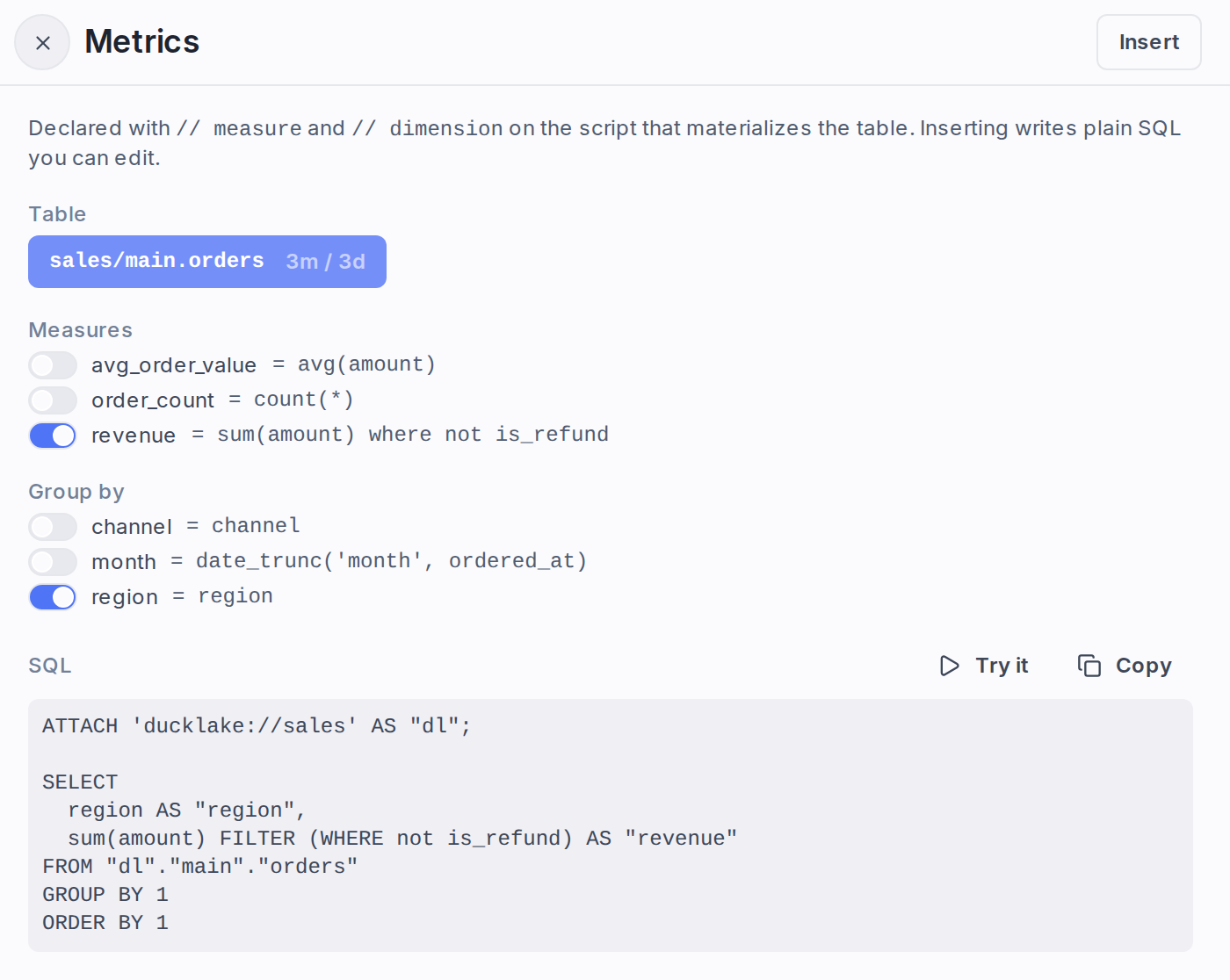
Every DuckDB script's editor bar has a Metrics button (and an entry in the compact Helpers menu below the width threshold). Opening it browses the workspace's declared catalog and preselects a table the open script appears to reference.
Tables that declare metrics are listed with their measure and dimension counts, so you can switch between them. Selecting measures and dimensions composes a plain SELECT client-side: dimensions become the GROUP BY/ORDER BY, each measure renders as its aggregate (with a FILTER (WHERE …) when it carries a predicate). A name filter appears once a table declares more than a handful of metrics, and a table filter once there are many tables, so large catalogs stay browsable.
The composed query is always complete and runnable - it attaches the lake itself under the conventional dl alias. Three things to do with it:
- Copy it.
- Run it in an embedded SQL REPL against the lake, to check a metric against real data before it goes anywhere.
- Append it to the script. Insertion adapts: if the script already attaches that lake, the snippet reuses that alias and omits the
ATTACH(repeating one would fail). The snippet is appended rather than inserted at the cursor, since it is a whole statement block that must follow anyATTACH.
The output is ordinary editable SQL with no link back to the catalog - change it freely after inserting.
Agents
The catalog is also exposed as an MCP tool, so an AI agent can ask what a table or a folder declares and use the declared aggregate and filter instead of inventing its own. This is the main point of declaring metrics: an informed writer - human or agent - uses the canonical definition rather than guessing at it.
What this deliberately does not do
Measures and dimensions inform; they do not constrain. Three boundaries are intentional:
- It does not enforce anything. Nothing stops a person or an agent from ignoring a declared measure and writing
sum(amount)without the refund filter. The bet is that most wrong numbers come from not knowing the rule, not from defying it. - It is not a semantic layer. Declarations are single-table: there is no join planner and no fan-out-safe aggregation across grains. To combine tables, materialize a mart with a pipeline step and declare measures on that.
- What you deploy is what runs. Nothing rewrites or executes your SQL at query time - the drawer and agents compose new SQL from the declarations, they never substitute anything into the script that materializes the table.
Deploy validation
Because a reader executes the stored expression text, deploy hard-rejects declarations that could be unsafe or silently wrong:
- an unsafe lake or table path,
- a measure or dimension body that is not a single SQL expression (both would be a stored SQL injection into whoever runs the composed query),
- a filtered measure whose body is not a single aggregate call -
sum(a) / count(b) where …would apply theFILTERto only part of the expression and silently produce the wrong number.
Everything else is advisory. Missing-column and non-aggregate-measure warnings come from the schema-contract check the editor runs on save, so a name that does not match the producer's captured schema is flagged in the editor but does not block deploy. A CLI or direct-API deploy skips those warnings, and a declaration whose SQL is otherwise wrong is only discovered when someone runs it.